
Content note: this post talks about miscarriage, pregnancy loss and cancer treatment. Please look after yourself while reading.
“I wanted to have a baby, instead I got cancer.” That was the thought that kept going through my mind as I found myself checking into a cancer ward.
Before you read on, I want to confess how scary it is to share something so deeply personal. But if it helps even one person feel less alone on this isolating path, I’m glad I wrote it.
Where my story begins
To begin my story, we need to rewind to 2013, when I first arrived in the UK with a bag full of dreams. We met on a winter night at a local pub. A classmate and I had decided that to learn English properly, we needed to practise with locals. He was there with a friend, hoping to pick up some Spanish before going on holiday. Little did we know how that night would change our lives forever.
Growing up in Colombia, a Catholic country, makes you very aware of what the role of a woman “should be”: to have children and look after the home. I was so lucky to have a loving, forward-thinking family, and I never felt pressured to take the traditional route. Instead, my wonderful mum encouraged me to dream big, travel the world and chase my dreams.
Falling in love was so easy and natural. We shared values, goals and a love of music. We talked early on about whether we wanted children, but I was never someone who grew up dreaming of being a mum. We were happy with just the two of us for the time being. But when you reach a certain age, things can change, and we decided we felt ready to try.
I was naive to think getting pregnant would happen easily. Don’t get me wrong, for some people it does, but not for us. After months of trying, two lines finally showed up on the test, and we were so happy to be starting a new chapter of our lives.
“There is no heartbeat”
At 8.5 weeks, we booked a reassurance scan and heard the words no pregnant woman wants to hear: “There is no heartbeat.”
I thought the miscarriage would be the worst part. Little did I know what was waiting ahead.
Since that day, everything has been a blur. I had a D&C (a procedure to remove the pregnancy tissue), and only a few weeks later I was told the pathology results showed the tissue was abnormal. For the first time in my life, I heard the words “partial molar pregnancy.” I was confused and scared. I didn’t even know what it meant. I spent countless hours reading about what it was and what could happen, and searching for stories from anyone who had been through it.
Hearing the words partial molar pregnancy, persistent trophoblastic disease and cancer.
From miscarriage to a cancer ward
For a couple of days, I pretended things were fine. I went out for lunch and drinks, did some shopping, and put on a brave face for my friends and family.
But my follow-up blood tests showed my pregnancy hormone (hCG) was rising instead of falling, and a scan found tissue still growing in my womb. Then one night the bleeding was so severe that I had to go to A&E, and I was admitted because of the blood loss.
The blood loss left me anaemic, and the next day I was transferred to Charing Cross Hospital in London, one of the UK’s three specialist centres for this condition.
Inside Charing Cross
The days at Charing Cross were a whirlwind of tests. More blood tests than I could count, a specialist Doppler ultrasound to look at the tissue in my womb and the blood flowing to it, and a chest X-ray to check whether anything had spread to my lungs.
The scan showed the mass in my womb had grown to over 5cm. Then the chest X-ray came back clear, and it was the first truly good news I’d had in weeks.
It was there that it was confirmed: persistent trophoblastic disease, a rare type of pregnancy-related cancer.
Did you say cancer? It was an absolute shock. I had never known that a pregnancy could develop into cancer. How did we get here? From wanting a baby to checking into a cancer ward?
The doctors explained that they use a scoring system to decide on treatment. It looks at things like your hCG level, the size of the mass, how long it’s been since the pregnancy and whether it has spread. A score of 0 to 6 is low risk. Mine was 4.
Then came the word chemotherapy, and the terror of the side effects. But there was a silver lining: for low-risk disease, the cure rate is close to 100%, and I could let myself believe that things would get better.
Writing from my hospital bed
I’m writing these words from my hospital bed, in a room full of brave, wonderful women who have unfortunately “won the C lottery.” We’ve joined the club nobody wants to be part of, but one that around one in two of us in the UK will join at some point in our lives.
I still don’t know how this story ends. I can only hope the worst has already happened, and that I will get better.
From my hospital diary
During my stay, I kept a small notebook by my bed. These are some of the entries, written as I felt them at the time.
15 October
Overwhelmed to see how sick some of the women in my room are. A young woman, no older than 30, not even conscious, her partner by her side asking the doctors questions no one should ever have to ask. A lovely older lady talking to the palliative care doctor about how they can help her manage her pain. At first I felt like an impostor for even being here. I’m not that sick, and I don’t deserve to be here.
16 October
My half birthday, and a little joy amongst this strange time. Feeling so loved and lucky to have my family and James. Every day I thank whoever is up there for sending me the most wonderful man to spend my life with. Hard times test character, relationships and beliefs. I’m so glad I made the decisions that led me here, and in spite of everything, I feel very lucky.
17 October
How is it possible to feel so happy and full of love, and at the same time sad, wondering why things couldn’t be like that for me? Seeing my beautiful niece, people I know announcing pregnancies and sharing photos of their newborn babies while I’m in hospital. Life doesn’t feel fair sometimes, but self-pity is never good. I know I will be healthy again, and as long as I have that, James and my family, I can be happy again.
18 October
The first night I haven’t felt like crying. My meds have been reduced and I’ve felt fine. I finally agreed to my first visitor who isn’t James, and it was okay. I think I feared the look on people’s faces when they saw me: shock, sadness, worry. But that’s what friends are there for, to support us in the good and the not-so-good times. Two more sleeps until I’m home. How much I miss the simple things in life. I will never take anything for granted again.
19 October
Another night with no tears, just full of hope that this will be my last night in hospital for a while. Today we went to Maggie’s. The place was so beautifully designed. Strange how I knew about these centres from design competitions, but never thought I’d be using their services. They signed me up to a virtual group for women currently being treated for GTD. I’m hoping to connect with others going through this, and to learn how other families are coping. This last week has been so surreal (one week since A&E), but I’m glad to be getting better.
20 October
Finally back home. So happy, but also overwhelmed. It’s like I forget everything that’s going on for a few seconds, only to remember it all again. Feeling exhausted, mentally and physically, and wondering what this new “normal life” is going to be like. But I know I have to take it day by day and focus on the positives: James, Derek (our cat), my family, being home. It won’t be easy, but I know I’m strong enough to get through this.
23 October
My first couple of days at home: wanting to do so much, but able to do so little. Yesterday I pushed myself to record a video I’d agreed to before all this happened, and boy, was that a bad idea! The bleeding got so heavy that I wondered if I’d need another trip to A&E. I took another dose of tablets this morning and it’s better, but Charing Cross have said they won’t prescribe more. I simply need to rest and do less. Feeling like a dead weight.
What chemo is really like: two weeks in
I started chemotherapy on 15 October. My treatment is a drug called methotrexate, and it’s nothing like the chemo I’d pictured.
Each cycle lasts two weeks. I have an injection in my bum every other day for eight days, with folinic acid tablets on the days in between. The folinic acid helps protect my healthy cells, which is why the side effects are usually mild. Then I have six days off before the next cycle starts. I’ll keep going until my hormone levels are back to normal, plus a few extra cycles to make sure every last cell is gone. In total, treatment should take three to five months.
So far, my side effects have been:
- An upset stomach right after my first dose, which then swung the other way to constipation
- Nausea that comes and goes, which anti-sickness tablets help to keep under control
- Breast tenderness, which is likely hormonal rather than from the chemo itself
- Anaemia from the blood I lost before treatment started
- Raised liver enzymes, which is common with methotrexate, so my blood is checked regularly
I haven’t lost my hair, and at this dose, I’m not expected to.
There are also everyday things that change during treatment. No alcohol. No folic acid supplements, because they can stop the methotrexate working. Daily SPF, because the skin burns more easily. And planning around injection days, which for me fall on Sundays, and this year, possibly on Christmas Day too.
The loss that got pushed aside
When we first lost the pregnancy, I did grieve. For around four weeks, I let myself feel it. Then the pathology results came back, and everything changed. Hearing the words “partial molar pregnancy,” and then “cancer,” meant the grief got pushed aside by appointments, blood tests and fear.
Now I’m so caught up in treatment, with injection days, blood results and side effects, that some days I almost forget I lost a little life. And when I remember, it hurts in a different way. That little life mattered, and I don’t want it to be forgotten in everything that came after.
I know there’s more grieving still to come, and when it does, I’ll let it.
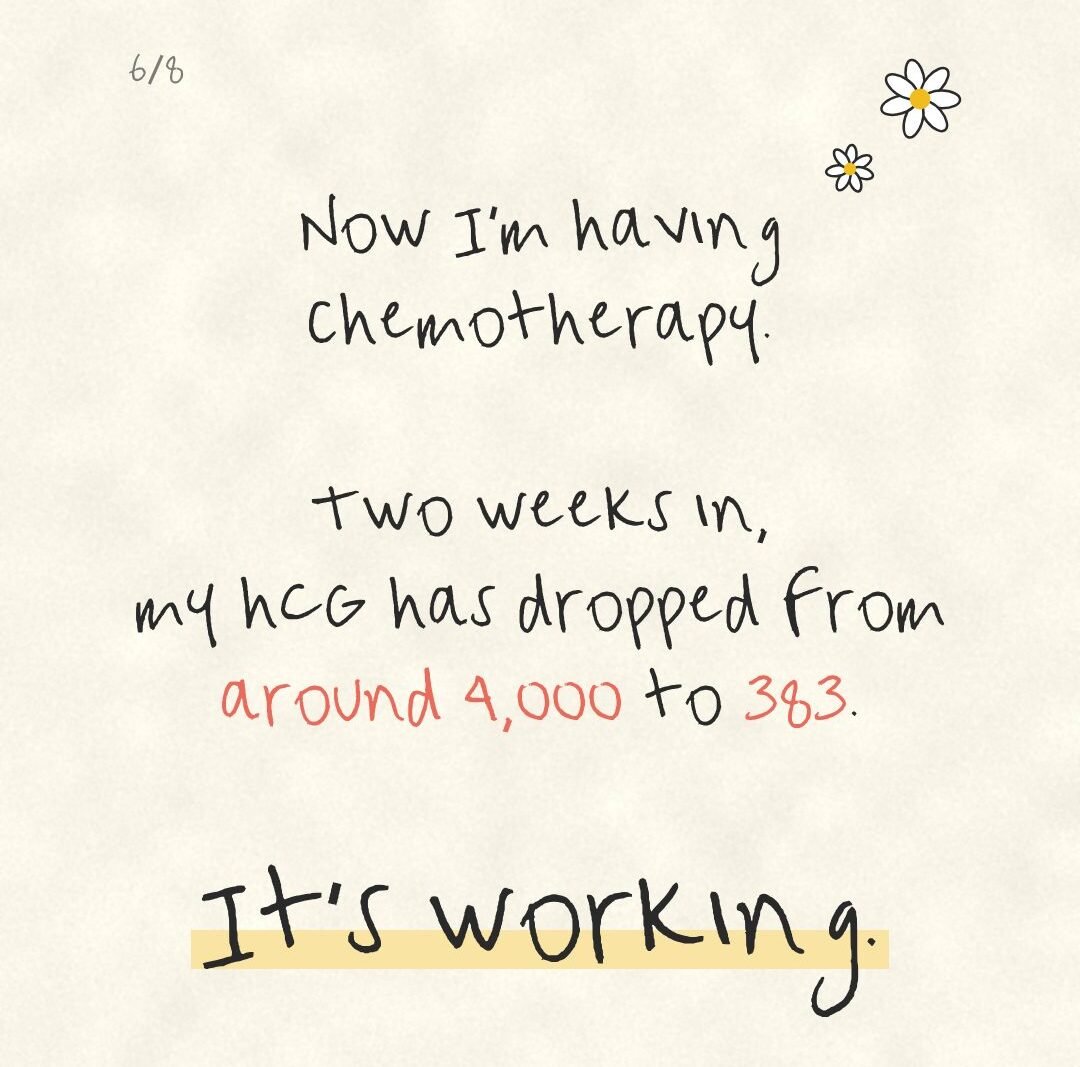
But here’s the part I want to hold on to: when I started treatment, my hCG was around 4,000. Two weeks later, it was 383. The treatment is working.
What is a partial molar pregnancy?
A molar pregnancy happens when a pregnancy doesn’t develop properly from the moment of conception. Instead of a healthy placenta and baby forming, the cells that should become the placenta grow abnormally. It affects around 1 in 600 pregnancies in the UK.
In a partial molar pregnancy, the egg is fertilised by two sperm instead of one, so there’s too much genetic material. The pregnancy can never develop into a healthy baby. It’s nobody’s fault, it can’t be prevented, and it often looks just like a missed miscarriage until the tissue is checked in a lab.
What is persistent trophoblastic disease (GTN)?
Most partial molar pregnancies clear completely after the D&C. In a small number of cases, around 1 in 100 to 1 in 200, some cells keep growing. This is called persistent trophoblastic disease or gestational trophoblastic neoplasia (GTN), and it’s treated as a type of cancer.
The good news is that it’s one of the most curable cancers there is. Low-risk GTN, like mine, is usually treated with a chemotherapy called methotrexate, and the cure rate is close to 100%. It doesn’t usually cause hair loss, and it doesn’t affect fertility long term.
Signs to look out for
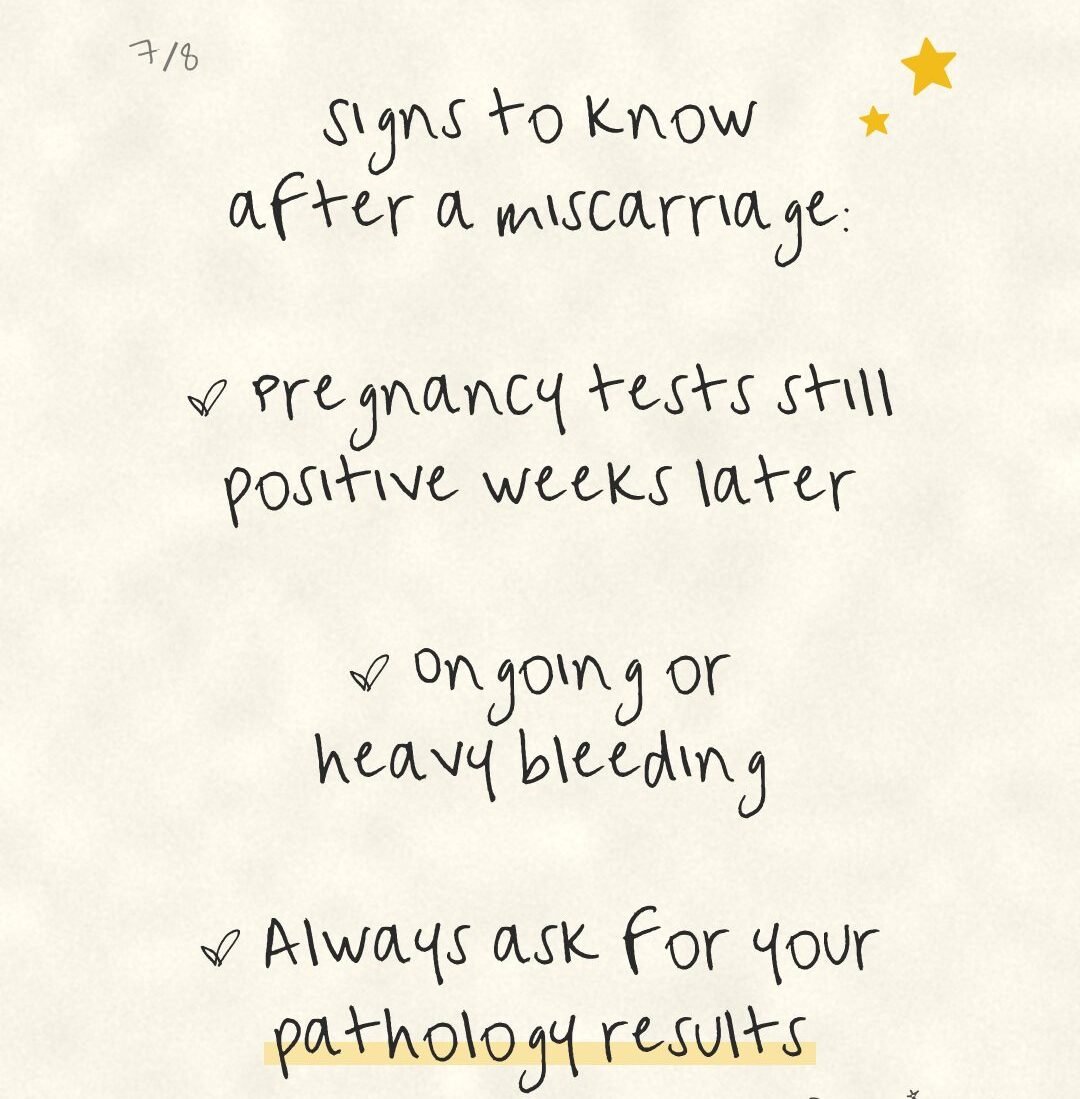
After a miscarriage or a D&C, speak to your GP or early pregnancy unit if you notice:
- Pregnancy tests still positive several weeks after the procedure
- Ongoing or heavy bleeding, especially with large clots
- Pregnancy symptoms that don’t go away, such as nausea or breast tenderness
What I want other women to know
- Ask for your pathology results after a miscarriage procedure. That’s how a molar pregnancy is found.
- Follow-up matters. In the UK, anyone diagnosed with a molar pregnancy is registered with a specialist centre (Charing Cross in London, Sheffield or Dundee) and has their hCG checked until it’s back to normal.
- Don’t rely on home pregnancy tests. Only blood or urine tests that measure the actual hCG level show whether it’s falling.
- Trust your body. If something doesn’t feel right, push to be seen.
- You’re not alone, even when it feels like it.
Where to find support
- Charing Cross Hospital Trophoblastic Disease Service: hmole-chorio.org.uk
- The Miscarriage Association: miscarriageassociation.org.uk
- Tommy’s: tommys.org
- Macmillan Cancer Support: macmillan.org.uk
- Maggie’s: maggies.org, free cancer support centres across the UK
If you’ve been through something similar, I’d love to hear from you. You can find me on Instagram @alexarciab.